Universal Design for Learning (UDL): Frequently Asked Questions and Resources
Universal Design for Learning is a long‑term approach to designing learning environments and experiences that reduce barriers, honor learner variability, and support learner agency. The resources below help instructors, instructional designers, student‑support professionals, and administrators move beyond an introduction to UDL and into reflective, sustainable practice. Together, they reflect both the foundational UDL framework and the expanded focus of UDL Guidelines 3.0, including belonging, identity, executive functioning, and collective intelligence.
Get Answers to Common Questions
No. UDL maintains high expectations for all learners. The learning goals stay the same; what changes is how students access information and show what they know. In many cases, UDL actually raises rigor by asking students to think more critically, reflect on their learning, and apply knowledge in meaningful ways.
No. UDL is proactive design, not retroactive accommodation.
- Accommodations respond to individual students after barriers appear.
- UDL reduces barriers from the start by designing flexible options that benefit everyone.
UDL
- Broad
- Works for “everyone”
- Benefits accessibility
- Proactive approach
- Reduces need for accommodation
Accessibility
- Case-by-case
- Based on individual needs
- Ensures accessibility
- Responsive approach
- Fills in gaps after implementation of UDL
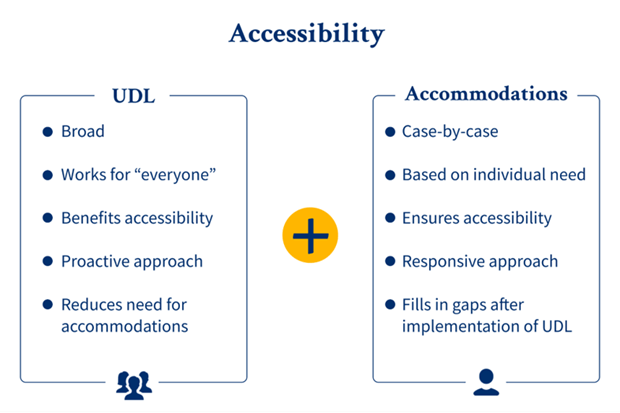
Accommodations are still important, but good UDL design often reduces how often they are needed.
No. UDL supports all learners, including:
- Multilingual students
- First‑generation and returning adult learners
- Students balancing work, caregiving, or military service
- Students with diverse cultural identities and learning histories
UDL is based on the idea that learner variability is the rule, not the exception.
No. UDL can be implemented incrementally. Small shifts make a big difference, such as:
- Adding choices to an assignment
- Providing clear goals and examples
- Offering content in more than one format
UDL is a continuous improvement mindset, not an all‑or‑nothing approach.
Not if the learning goals and criteria are clear. UDL encourages:
- Shared learning goals
- Transparent criteria or rubrics
- Flexible paths to reach those goals
When expectations are explicit, different formats can be graded equitably.
UDL intentionally supports engagement by design, especially through:
- Relevance to students’ lives and goals
- Opportunities for autonomy and choice
- Activities that promote belonging, identity, and purpose
UDL Guidelines 3.0 emphasize that students engage more deeply when they feel seen, valued, and capable.
UDL strongly supports collective intelligence—learning with and from others. Well‑designed collaboration:
- Builds communication and problem‑solving skills
- Reduces isolation
- Reflects real‑world work environments
UDL encourages intentional structures so collaboration is accessible, inclusive, and meaningful.
UDL recognizes that skills like planning, organization, time management, and self‑monitoring:
- Are learned, not assumed
- Vary widely across students and situations
Examples of UDL supports include:
- Checklists and timelines
- Scaffolded assignments
- Opportunities for reflection and revision
These supports help students become independent, self‑directed learners.
UDL is closely aligned with equity‑minded practice. By examining how design choices may advantage or disadvantage certain learners, UDL helps educators:
- Reduce systemic barriers
- Honor learner identities and lived experiences
- Foster a sense of belonging for all students
Belonging is not “extra”—it is foundational to learning.
The goal of UDL is learner agency — students who can:
- Understand their strengths and needs
- Make purposeful choices about learning strategies
- Advocate for themselves
- Continue learning beyond the classroom
UDL is not just about access—it’s about preparing learners for lifelong learning.
Resources
UDL Guidelines 3.0 (CAST)
What it is: The most current, research‑based version of the UDL Guidelines, released in 2024.
Why it’s useful: This is the foundational UDL resource. Version 3.0 emphasizes learner agency, addresses systemic and design‑based barriers, and foregrounds belonging, identity, collaboration, and executive functioning supports. Ideal for educators who want to understand the why behind UDL.
About the UDL Guidelines 3.0 Update
What it is: An explanation of how and why the UDL Guidelines were updated.
Why it’s useful: This resource provides helpful context around the equity‑centered evolution of UDL and explains how insights from learners, practitioners, and researchers shaped the new guidelines.
UDL Framework Overview (CAST)
What it is: A clear overview of UDL, including the three principles and key assumptions.
Why it’s useful: This is an excellent plain‑language introduction to share with new faculty, staff, or cross‑functional teams who need a shared understanding of UDL.
UDL On Campus: UDL in Higher Education
What it is: A dedicated CAST resource focused on postsecondary education.
Why it’s useful: Designed specifically for colleges and universities, this site includes guidance on getting started, course examples, and institutional initiatives relevant to community college environments.
AccessATE UDL Case Studies
What it is: The case studies document real instructional and programmatic scenarios in postsecondary STEM and technical education where UDL principles are applied.
Why it’s useful: The case studies are grounded in authentic community college environments, making them especially relevant to instructors and staff working in applied and workforce‑focused programs.
CAST UDL Community
What it is: An online community of UDL practitioners and advocates.
Why it’s useful: UDL is strengthened through collective intelligence. This community allows educators to share ideas, ask questions, and learn from others across institutions and roles.